
How to Avoid Double-Counting Amazon FBA Reimbursements
Review overlapping exports, repeated reimbursement IDs and cash or inventory compensation without inflating your Amazon FBA audit totals.
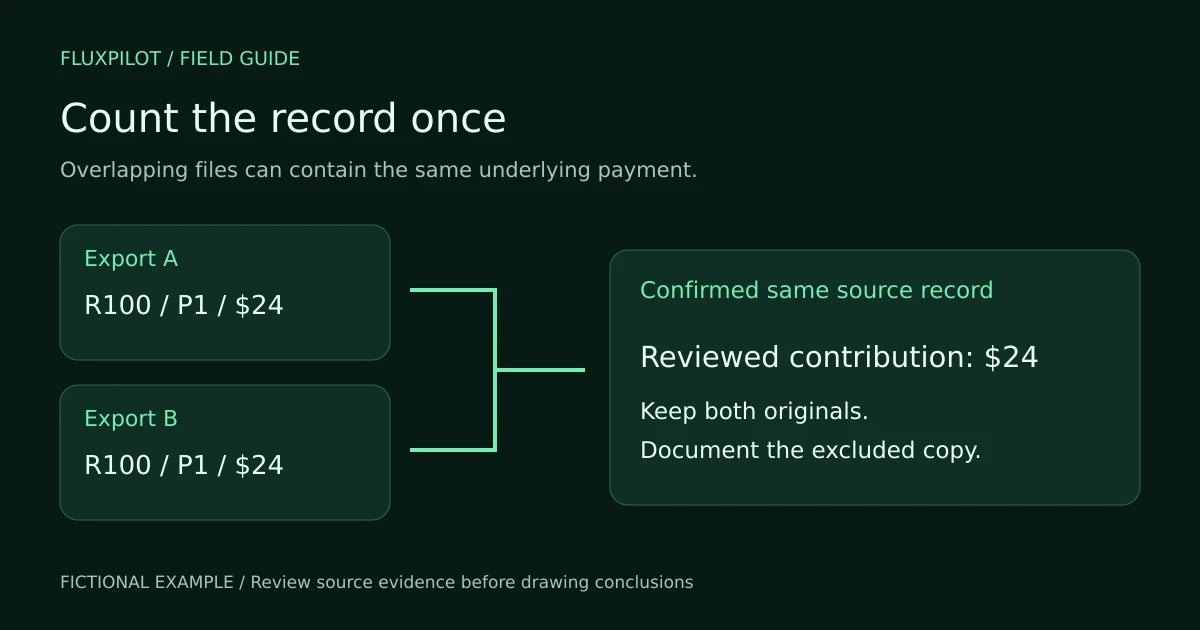
Keep the original exports, identify their overlap, compare complete item-level records, and record why any row is excluded from your working total. Never treat a shared reimbursement ID or equal amount as proof of duplication. Count cash and inventory resolutions separately and match each to the event it actually resolves.
Start with the question your total should answer
An audit can contain several useful totals: cash appearing in the supplied history, units covered by verified compensation, and events still requiring investigation. They answer different questions. Adding every number visible in every file produces a total that may answer none of them.
This guide describes a manual review method for your own working records. It does not establish that Amazon paid twice, that a claim is eligible, or that FluxPilot automatically removes every duplicate. Your source files remain the evidence; the working total is a documented interpretation.
Preserve two layers: original files and the review copy
Save each original export unchanged. In a separate review copy, add source filename, reporting period, export time and original row number. These review columns let you trace a suspect line back to its source without changing what the source said.
Mark potentially overlapping files before combining them. For example, a September export and an export covering September plus early October share a date range. That overlap is a reason to compare records, not permission to discard every September line. A later export may contain information that the earlier file did not.
If the period or account is unknown, resolve that uncertainty first. Do not combine histories from different seller accounts or currencies into a single undifferentiated amount. Keep exclusions visible with a reason and the retained record reference.
Compare a complete record, not just an amount
Amazon documents itemized reimbursement records with identifiers, product fields, amounts and cash or inventory quantities. Use the fields present in your export together when comparing suspected repeats.
A reimbursement ID is a useful starting point for review, but an ID alone does not describe the entire item-level line. Different products or quantities must not disappear because a spreadsheet deduplication command used only one column. Likewise, two equal amounts can be legitimate separate payments.
A practical comparison includes account context, reimbursement reference, product identifier, approval date, currency, signed amount and compensation quantities. Retain original-payment references when supplied. If any field differs, keep both rows until you can explain the difference. Even a full-field match should be checked against export overlap and source evidence before exclusion.
Worked example: repeated export versus distinct compensation
The following records are fictional. Export A contains a $24 line for product P1 with reference R100. Export B contains the same documented line, plus a $12 line for P2. Source review confirms the $24 line is the same underlying record in overlapping exports.
The naive sum is $60: $24 + $24 + $12. The reviewed total is $36 because the second copy contributes zero to the working sum. The P2 line remains even if a reference happens to be shared. This example illustrates record handling, not an expected Amazon payout.
| Source row | Cash shown | Working contribution | Review reason |
|---|---|---|---|
| A / P1 / R100 | $24 | $24 | Retained source record |
| B / P1 / R100 | $24 | $0 | Confirmed repeat of A |
| B / P2 / R101 | $12 | $12 | Distinct item record |
| Reviewed total | $36 | Original rows preserved |
Keep payment reversals and inventory resolutions distinct
A negative adjustment is not a duplicate merely because its absolute amount equals an earlier payment. Preserve its sign and investigate the relationship. Removing the negative line can make net compensation look larger than the supplied history supports.
Cash reimbursement and inventory compensation are separate forms of evidence. A found movement and an inventory reimbursement entry might describe the same resolved units. Establish the relationship before counting both as independent resolutions. Product-level similarity is not enough to prove which incident was resolved.
For an uncertain relationship, use a status such as needs matching. Keep uncertain coverage out of a confirmed recovery total until the evidence supports the conclusion.
Finish with a repeatable reconciliation check
Before accepting the working total, reconcile it back to the original rows. Every included line should contribute once. Every excluded copy should point to its retained counterpart. Every unresolved conflict should remain visible rather than silently disappearing.
Then revisit the inventory events using the cleaned history. A smaller compensation total does not by itself create a claim; it may simply correct your previous calculation. Document what changed and why so the next reviewer can reproduce the result.
Use FluxPilot to organize report-based inventory findings, supplied costs and reimbursement history. Complete the source-level overlap review before relying on a combined total, and verify actual event matching before deciding your next action.
- Keep account and currency boundaries intact.
- Preserve signed amounts and payment relationships.
- Record the reason for each excluded copy.
- Compare the revised total with the source evidence.
Frequently asked questions
Can I remove duplicates using only reimbursement ID?
Do not use that as a blanket rule. Compare item-level information and source overlap, preserving distinct product lines and documenting any confirmed repeat.
Does a duplicate in my spreadsheet mean Amazon paid twice?
No. The same source record may have been imported from overlapping exports. Establish the underlying payment history before making that conclusion.
Sources and further reading
Workflows and examples are from FluxPilot. Amazon policies change; verify the current policy for your marketplace before filing a claim.
Amazon FBA Reimbursements Report: official field definitions