
Amazon FBA Received Then Reversed Units? How to Investigate Negative Receipt Entries
Amazon's Inventory Ledger shows FBA units received and then removed with negative Receipt transactions. Learn to reconcile units, shipment records, carton evidence and Seller Support responses.
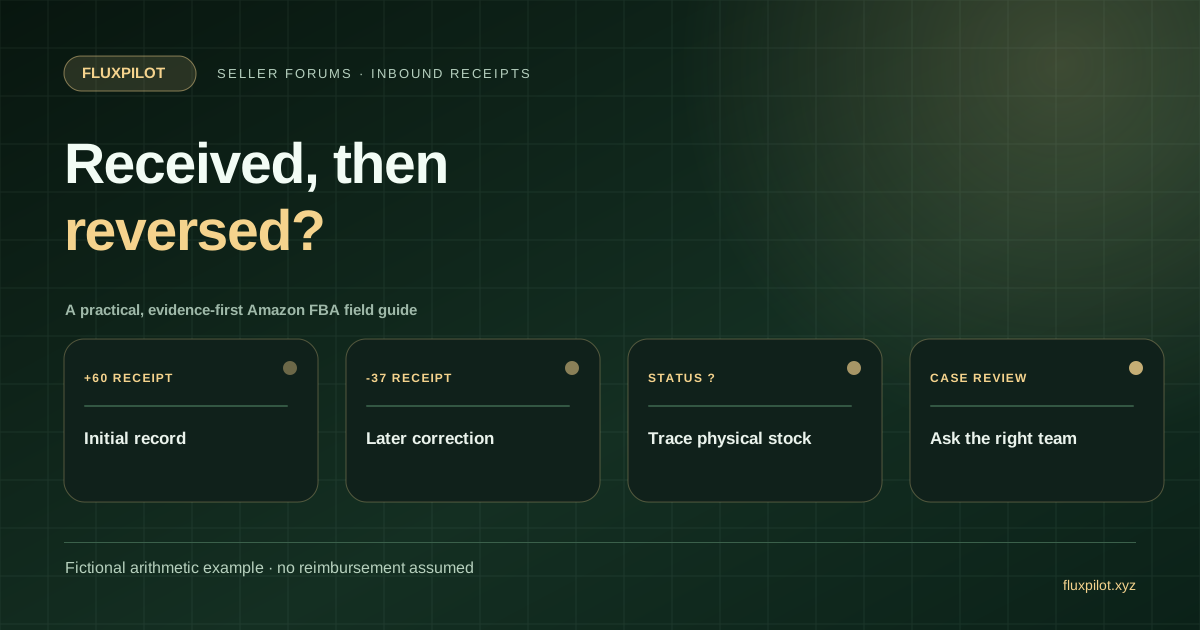
A negative Receipt entry following a positive received event deserves a documented inbound reconciliation, but it does not by itself prove Amazon lost physical inventory. Keep both dated ledger rows, shipment ID, box content evidence, unit identifiers and all later adjustments. Compare the signed quantities without deleting the original receipt; then ask Seller Support to explain the exact reversal and physical inventory disposition. Follow the inbound-claim rules of your marketplace rather than the warehouse-loss window by default.
The real seller question: why did Amazon reverse a confirmed receipt?
A 2026 Seller Forums discussion describes a shipment with positive receipt rows followed by negative Receipt transactions for some of the same units. The seller reports that support focused on a carton-weight explanation rather than reconciling the subsequent ledger reversals. This is an example of an unresolved evidence question, not proof that Amazon deliberately misreported inventory.
The correct first step is to treat a positive receipt and a later negative receipt as two distinct dated records. The second entry may be a correction or part of an inbound investigation; the precise physical meaning cannot be inferred from the sign alone. Preserve the original rows, not just a screenshot of the net balance.
An inbound discrepancy and an in-warehouse loss are not interchangeable. A claim can fail even if arithmetic shows fewer net units, because the applicable rule, proof and start date depend on what happened.
Create an event timeline before comparing reports
For each FNSKU, copy all receipt-related and later adjustment rows covering the same shipment and account into a working review sheet. Retain event timestamp, reporting timestamp, shipment ID if available, SKU/FNSKU/ASIN, quantity sign, disposition, reference ID and the source file name.
Do not use a product-only join when a product has shipments in the same month. A receipt for the same FNSKU in Shipment B cannot automatically explain a reversal on Shipment A. When the report does not expose a reliable shipment relationship, the case must say so.
The audit question has two parts: why did the system reverse the receipt and where is the physical inventory accounted for now? Both need support from evidence. A net-negative line alone does not answer either.
| Date | Record | Units | What it establishes |
|---|---|---|---|
| May 6 | Receipt +60 | 60 received | Positive accounting event |
| May 19 | Receipt -28 | 28 reversed | Later correction; reason unknown |
| May 23 | Receipt -9 | 9 reversed | Another change; not a claim decision |
| May 30 | No identified later resolution | Unknown | Must check all relevant reports |
| Audit result | Net +23 in this selected chain | 23 | Does not prove physical location or eligibility |
Use a shipment-reconciliation packet rather than one screenshot
Keep the original shipping plan and shipment contents as submitted, carton counts, tracking and delivery records, any permitted packing evidence, and the Seller Central shipment workflow's received and expected quantities. Compare dates and quantities line by line with the Inventory Ledger.
Carrier proof of delivery establishes delivery to a location under the carrier's record; it does not automatically establish that every specific FNSKU was received correctly. Camera footage may support packing activity but does not itself show what Amazon scanned or accepted. These pieces become stronger when reconciled with the same shipment and carton labels.
Record any mismatch in a short table. For example, 'Shipment contents expected 60; initially booked 60; later negative Receipt 37; physical resolution unknown.' Avoid asserting a missing quantity is fully eligible without checking later records and the inbound policy.
- Shipping plan and shipment ID.
- Box-level contents and labels where available.
- Carrier tracking and delivery confirmation.
- Original Inventory Ledger rows with dates and signed quantities.
- Other relevant receiving and inventory activity.
- Prior case responses and their exact unresolved question.
Distinguish three possible next actions
One path is inventory restoration: the shipment data suggests a receipt correction may have removed sellable units that still need locating or reinstating. Another is inbound shortage review: the final received count does not match expected shipment contents and the category's specific policy may apply. A third is warehouse loss/damage review: Amazon later recorded a distinct qualifying event after receipt.
These paths have different clocks. For Europe, an Amazon announcement effective September 23, 2026 described a maximum 30-day missing-from-inbound claim window calculated from shipment receive date, with a transition period through October 23 and at least a 14-day wait. Confirm the exact local workflow; do not apply a US warehouse-loss 60-day rule to an EU inbound shortage.
If the date category is unclear, request clarification promptly and preserve evidence. Never solve timing ambiguity by changing the original receipt date or presenting one market's rules as global.
| Evidence | Likely request | What to verify |
|---|---|---|
| Units confirmed received then negative Receipt | Inbound record and physical trace | Reason for reversal, later inventory status |
| Expected shipped exceeds accepted received | Missing-from-inbound discrepancy | Shipment contents, receive date, local policy |
| Separate later loss/damage movement | Warehouse event review | Event reference, later resolution, warehouse policy |
A concise, evidence-based Seller Support question
Suggested case wording: 'For shipment [ID] and FNSKU [ID], the original Inventory Ledger shows Receipt +[quantity] on [date] with reference [A]. A subsequent Receipt -[quantity] appears on [date] with reference [B]. Shipment contents and the current stock report do not explain that reversal. Please identify the reason for the negative Receipt event, the associated receiving evidence or current disposition, and whether the correct resolution is inventory restoration or an inbound discrepancy investigation.'
If support answers only that carton weights differ, ask how that explanation maps to the exact original receipt and later negative rows. Keep the tone factual and reference the same case log so another reviewer can see the sequence.
If Amazon confirms a loss and explains the reimbursement path, re-check later inventory and payment records. FluxPilot currently focuses on supported inventory-ledger lost/damaged review; it does not access internal dock scans or decide an inbound claim.
Avoid five errors that make a strong case harder to review
Do not delete the positive receipt, collapse all signed rows into one 'Amazon stole stock' total, join transactions by ASIN only, ignore a later correction or apply a claim deadline from the wrong category. Those shortcuts can create a dramatic but unreproducible spreadsheet.
A better outcome from the first support exchange is a clear reason code, event linkage or the explicit admission that more investigation is needed. A well-scoped unresolved case is more useful than a confident but unsupported payout estimate.
Frequently asked questions
Does negative Receipt prove Amazon lost my shipment?
No. It records a negative receiving-related transaction; investigate what corrected receipt quantity, physical disposition or later movement explains it.
Can I use the normal warehouse lost-inventory claim window?
Not automatically. An inbound shortage and a later warehouse loss are different incident types and may have different filing rules.
What if support says carton weight is wrong but skips the ledger?
Present the signed receipt timeline and ask a narrow question connecting the carton evidence to the specific reversal and physical status.
Does FluxPilot verify Amazon warehouse scans?
No. Its current scope is supported inventory-ledger lost/damaged event analysis using the reports the seller provides.
Sources and further reading
Workflows and examples are from FluxPilot. Amazon policies change; verify the current policy for your marketplace before filing a claim.
Amazon seller forum: original receipt followed by negative Receipt entries Amazon seller forum: support case closed without addressing ledger evidence Official Amazon FBA report type definitions Amazon Europe Sep 2026 missing-from-inbound update