
Amazon FBA Reimbursement Claim Denied? Match the Rejection to the Evidence
Amazon denied your FBA reimbursement claim or closed an inventory case without explaining the ledger? Use a reason-by-reason evidence checklist, example reply and appeal triage.
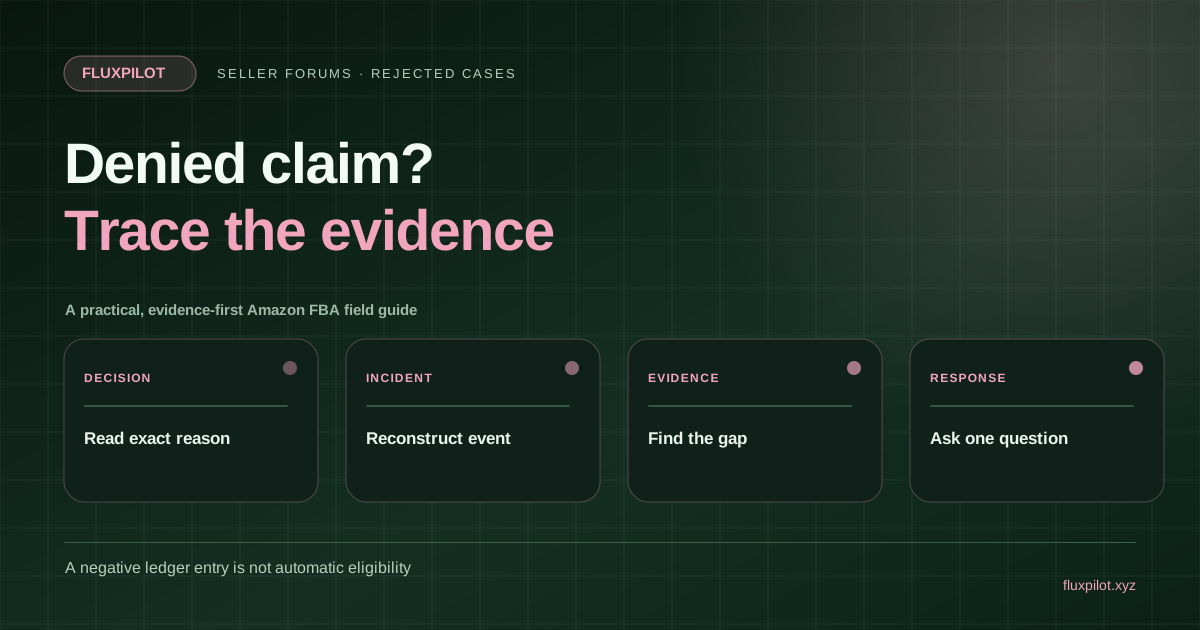
Read the exact denial and identify what Amazon assessed. Reconcile the event, later inventory corrections, reimbursement history, source cost and marketplace policy before resubmitting. Reply to the appropriate existing case with the original reference, specific contradictory evidence and one focused question; do not treat a negative ledger movement as automatic proof that a reimbursement is due.
First establish what Seller Support actually rejected
A reply may reject an inbound shortage, an inventory restoration request, a lost/damaged inventory reimbursement or an amount dispute. Those are different decisions even if they involve the same product. A recent Amazon Seller Forums discussion illustrates a seller asking to restore physical inbound stock while receiving a generic reimbursement response. The public thread does not prove the private account's true inventory status.
Copy the case ID, decision date, exact conclusion, seller account, marketplace and incident reference. Write a one-sentence description of the issue originally submitted and compare it with the issue Amazon appears to have evaluated.
Check the active policy for the incident category and event date. The day you received the refusal or downloaded the report does not necessarily start a new submission window.
| Response pattern | Evidence to inspect | Focused question |
|---|---|---|
| No eligible lost event | Inventory Ledger reason and later movements | Which event or resolution was used? |
| Carton contents or weight mismatch | Shipment plan, box record, signed Receipt timeline | How does this explain the exact negative receipt? |
| Already reimbursed | Original reimbursement, reversal and found inventory | Which payment or correction resolved this reference? |
| Cost basis not accepted | Invoice date, supplier cost and SKU match | Which document or value is missing? |
| Outside a deadline | Marketplace, event category, source date and policy | Which rule and start date apply? |
Reconcile each event before challenging the answer
A negative quantity may be followed by a found movement or reimbursement. Equally, a product can have several events for the same FNSKU, so a payment elsewhere in its history does not prove this specific incident was settled.
Build a small packet with the original report row, event reference, quantity, dates, subsequent movements, reimbursement IDs, reversals and the cost document. Keep ambiguous associations marked possible rather than treating a convenient ASIN match as evidence of a paid case.
If the source export overlaps an earlier file, do not count the same event twice. A reconstructed incident chain is stronger than a screenshot of a negative number.
Example: Seller Support missed the negative Receipt timeline
Fictional case: an inbound shipment lists 60 units initially received and a Receipt -20 transaction three weeks later. Support's explanation focuses on a carton-weight discrepancy. The seller's useful question is what caused the receiving correction and where those 20 units are now recorded, not whether the negative number itself proves Amazon owes a payment.
Attach the shipment ID, planned contents and the original signed ledger rows. Ask for the reversal's reason, the relevant receiving evidence or current disposition, and whether the appropriate next step is inbound reconciliation, restoration or a qualifying loss review.
For European missing-from-inbound events, Amazon announced a shortened window effective September 23, 2026, with a transition and waiting-period rules. Do not apply a US warehouse-loss deadline to that event automatically.
A concise reply you can adapt
Write in the existing relevant case log: 'For case [ID] and marketplace [market], your response on [date] states [decision]. Our original report shows event [reference, date, quantity] and a later related row [reference, date, quantity]. We checked reimbursement history through [date] and found [exact fact or uncertainty]. Please clarify which event or payment was used to reach the decision, and what specific evidence would resolve this discrepancy.'
Use factual sentences and clearly labeled records. Do not threaten staff, invent warehouse scans, allege fraud without proof or repeatedly send identical requests. If an answer addresses the evidence, add it to the audit trail even if the reimbursement outcome is unfavorable.
A new claim can have a different eligibility window from a re-evaluation of a prior claim. Amazon's US October 2025 announcement lists separate category-specific timelines; verify the current rule inside your account.
Keep denial, delay and re-evaluation queues separate
A denied reimbursement is a decision to examine. A support case waiting for a receiving explanation is an unresolved operational question. A formal re-evaluation request may have its own policy and deadline. Combining all three into one 'appeal' category makes deadline tracking and next actions less reliable.
Classify your record as closed with evidence, awaiting response, missing source documents, policy check needed or case ready for review. The metric that matters is a verifiable explanation or documented next action, not the number of repeated submissions.
FluxPilot helps examine supported Inventory Ledger loss/damage findings and organize optional cost and reimbursement evidence. It does not automatically file Amazon claims, access internal receiving scans or guarantee a successful dispute.
Frequently asked questions
Should I submit the same documents again after a claim denial?
First identify the exact objection and whether your documents answer it. Repeating identical evidence without addressing the stated problem may not help.
Does a negative Inventory Ledger row prove Amazon owes a reimbursement?
No. Check later resolutions, associated reimbursements, event identity and current eligibility rules.
Is an inbound shortage denial the same as a warehouse loss?
No. The event categories may use different reports, proof and filing windows.
Will FluxPilot automatically appeal the decision?
No. It assists with supported report-based review but does not submit Seller Central cases or guarantee an outcome.
Sources and further reading
Workflows and examples are from FluxPilot. Amazon policies change; verify the current policy for your marketplace before filing a claim.
Amazon seller case closed without addressing the Inventory Ledger Amazon seller report: initial receipt and later negative Receipt Amazon US claim-window update Amazon FBA report type definitions