
Amazon FBA Shipment Missing a SKU That Isn't in the Ledger: What Can You Prove?
One SKU was packed and shipped but is absent from Amazon inbound shipment contents or Inventory Ledger. Learn the evidence limits, reconciliation steps and marketplace deadlines.
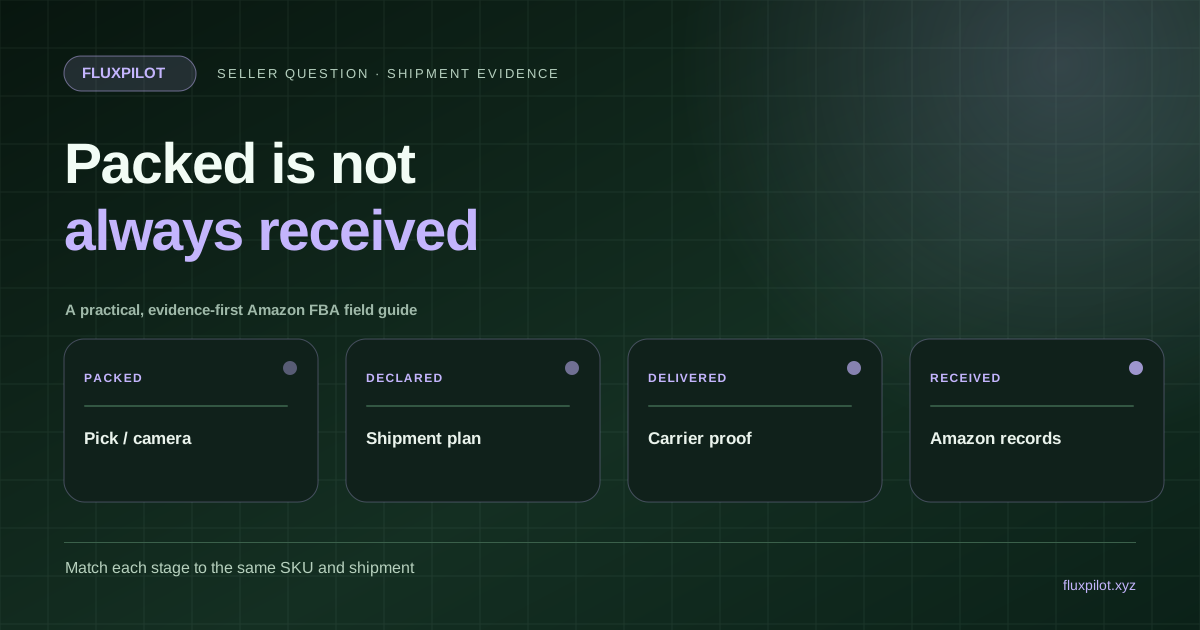
If a SKU appears in your packing records but not in the FBA shipment contents or ledger, first identify whether it was included in the shipment plan Amazon accepted. Compare the created shipment, box content labels, carrier delivery, received rows and any later unknown/unexpected inventory adjustments. If the original plan omits the SKU, a receiving or mislabeling investigation may be more appropriate than an ordinary reimbursement claim. Keep both explanations open and verify marketplace-specific policy deadlines.
The forum scenario: packed product, but Amazon has no record for that SKU
In a September 2026 r/FulfillmentByAmazon discussion, a seller explained that one labeled SKU from a multi-SKU shipment did not appear in the shipment ledger, even though they believed it had been packed and had video of packing. The seller asked whether Amazon might find the units later. That question has no reliable universal yes-or-no answer without reviewing the account records.
There are at least three different states: what you physically packed, what you declared in the shipment plan and box content information, and what Amazon registered as received. A missing ledger row could reflect a missing receipt, a mislabeled item, an incorrect shipment plan, a report/filter issue or another cause. Each possibility needs different evidence.
Avoid telling Seller Support that proof of delivery confirms a particular SKU was scanned. It supports delivery at the carrier level; the link to product-level receipt must be demonstrated separately.
Work through five stages of evidence
Build one timeline per missing SKU rather than treating a shipment's total carton count as product proof. Save original files and identify which report or business system generated each number.
Start from the shipment plan. If the SKU was never declared to Amazon, the problem is not the same as Amazon acknowledging the planned quantity then receiving too few units. A claim based on an incorrect assumption about the declared plan is easy to reject.
| Stage | Example record | What it establishes |
|---|---|---|
| 1. Warehouse packing | Video and pick list show SKU-B × 8 | Seller intended to pack eight; verify label linkage |
| 2. Shipment plan | Accepted contents list SKU-A but not SKU-B | SKU-B was not recorded as a planned item |
| 3. Box contents | Box-level manifest under review | Whether the units were declared by box |
| 4. Carrier delivery | Shipment cartons delivered | Carrier-level delivery, not SKU-level acceptance |
| 5. Amazon receipt/ledger | No SKU-B row in selected view | Needs filtering and alternate-identity investigation |
Check report scope and mistaken product identity before assuming loss
Inventory Ledger reports can be filtered by marketplace, account, product, dates and event type. Confirm you are using an event-level export spanning the receiving period and later adjustments, not only a current balance. Search by SKU, MSKU, FNSKU and ASIN where appropriate, preserving the original columns.
Check whether Amazon treated the item under an unexpected FNSKU or received it in a different condition. Don't silently relabel records until you have documentary confirmation. A shared ASIN doesn't establish that the missing units were received under a different SKU.
Also compare the shipment's Contents view, expected quantity, received quantity and discrepancies. If Amazon's original shipment plan genuinely lacks the SKU, make that omission explicit in your case rather than claiming the ledger proves a reported loss.
Understand why deadlines matter to an inbound problem
The relevant filing date may start from the shipment receiving event, not from the day you noticed an absent SKU. Amazon's September 2026 European notice specifically reduced the missing-from-inbound maximum to 30 days from receive date, with a transition through October 23, 2026, and states that sellers should wait at least 14 days after receipt before claiming.
That announcement is for the stated European inbound process; it should not be presented as a blanket US rule or as a guaranteed 2027 rule. Other event categories have different clocks. If you are unsure of the marketplace policy, record the uncertainty as urgent to verify rather than borrowing the 60-day warehouse-loss deadline.
In markets with a defined window, a seller should preserve the original receive date and escalate the evidence question quickly. Changing the start date to the latest export timestamp misrepresents the event and may hurt the investigation.
How to ask for a meaningful investigation
Suggested factual summary: 'Shipment [ID] contained cartons [identifiers]. Our picking/packing evidence shows [SKU and quantity]. The Seller Central shipment plan/Contents screen shows [exact declared quantity]; the receiving report shows [exact received quantity]. We cannot find a receipt or later adjustment under [SKU/FNSKU]. Please clarify whether these units were registered as unexpected inventory, received under another identifier or remain unaccounted for, and what evidence is required for the applicable inbound review.'
Attach the shipment plan and box-content details first; include carrier records and any packing evidence as supporting context. If one stage is missing, say so. Separate a request to locate physical items from a request to determine claim eligibility and value.
Where the account's submitted plan was wrong, ask what corrective process exists. Do not promise a reimbursement for an undeclared SKU: carrier delivery and packing evidence may still leave a proof gap.
Use the outcome to improve the next shipment
Create a manifest export before carrier pickup and reconcile it with what the shipment plan and box content information show in Seller Central. Use a second check of SKU, FNSKU and ASIN labels and a carton-level list; keep carton tracking tied to shipment ID.
For future audits, track expected, declared, received, adjusted and resolved units as separate columns. A binary 'lost/not lost' field loses the nuance that determines whether another step is needed.
FluxPilot currently analyzes supported Inventory Ledger lost/damaged events and optional reimbursement/cost history. An omitted inbound SKU can require shipment and carton evidence beyond FluxPilot's present supported report scope, so do not treat its review queue as a definitive inbound claim decision.
Frequently asked questions
If my packed SKU is missing from Amazon's shipment contents, will I get paid?
Not necessarily. You must investigate whether the item was declared, received, adjusted later and eligible under the specific marketplace policy. Packing evidence alone is not an automatic payout.
Does proof of delivery confirm every FNSKU was received?
No. Delivery of cartons does not establish the scanning and acceptance of every individual SKU or FNSKU.
Can Amazon find the units later?
Later adjustments or corrections are possible, but there is no universal prediction. Check later ledger records and ask for an accountable status review.
Which report should I check?
Start with the shipment Contents/received history and a relevant Inventory Ledger Detailed export, preserving dates and identifiers.
Sources and further reading
Workflows and examples are from FluxPilot. Amazon policies change; verify the current policy for your marketplace before filing a claim.
Reddit r/FulfillmentByAmazon, Sep 2026: Shipment Issue Amazon Seller Forums: receipt and reversal reconciliation question Amazon Europe missing-from-inbound 2026 announcement Amazon FBA report type definitions