
FBA Reimbursement Software 2027: Buyer Checklist, Costs and 7 Test Cases
Compare FBA reimbursement software in 2027 using seven auditable test cases, a transparent scorecard, pricing questions and an honest spreadsheet-versus-software-versus-service framework.
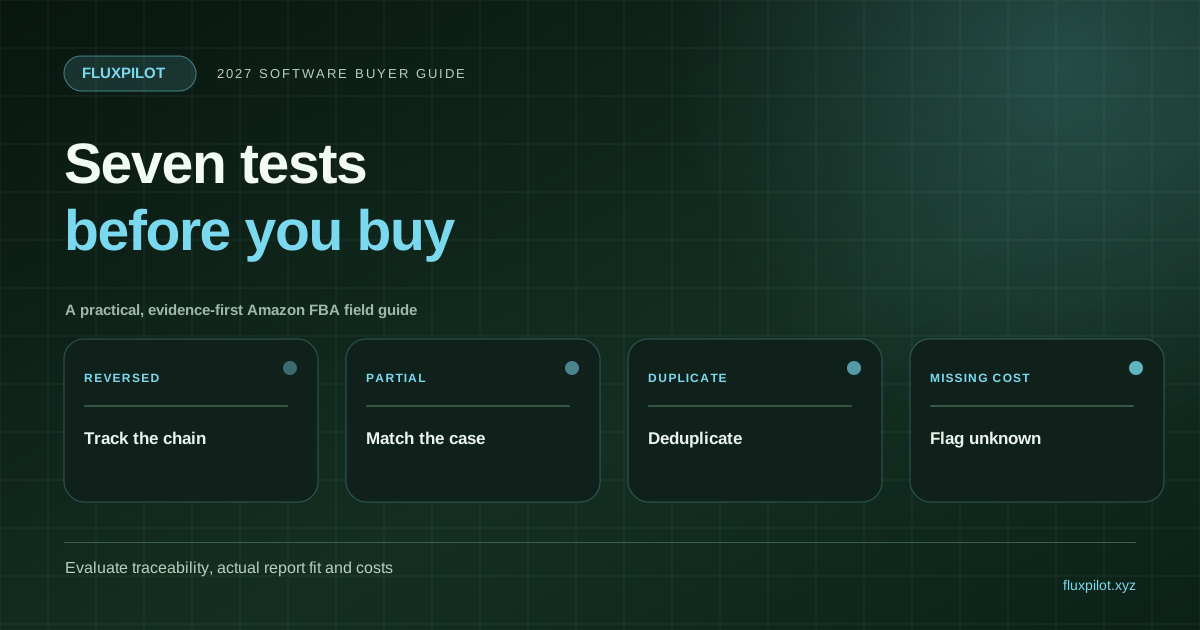
For a 2027 software purchase, require traceable incident-level evidence, clear marketplace and category coverage, exact permissions, explicit pricing and a pilot that handles later found inventory, reimbursement reversals and overlapping reports. Compare a spreadsheet, self-service tool and managed service on your actual workflow. No vendor is automatically 'best'; test accuracy, scope and cost instead of headline recovery figures.
Why the best workflow depends on your evidence—not a leaderboard
A seller with a few SKUs may be comfortable running a spreadsheet review. A seller with thousands of inventory events might need automated file parsing and a reconciliation queue. A seller who wants someone else to prepare disputes may evaluate a managed service rather than buying a tool. These are different products and fee models.
This 2027 buyer guide was prepared in October 2026. It does not predict 2027 vendor rankings or claim knowledge of unannounced future product features. Public comparison pages are useful starting points, but a real pilot with your file types and marketplace determines fit.
For any solution, ask who does the case interpretation, who contacts Amazon, whether submissions are automatic or manual, and what happens when the evidence is incomplete. If the provider cannot answer clearly, treat the capability as unverified.
| Approach | What you own | Questions to ask |
|---|---|---|
| Spreadsheet and manual review | Full control over formulas and supporting files | Can your team reproduce every join and keep up with deadlines? |
| Self-service software | Interpret findings and decide on cases; product helps organize | Which report formats, event categories and markets are supported? |
| Managed reimbursement service | Oversight, permissions and quality checks | Who submits claims, what commission applies, and what is excluded? |
Run these seven test cases before you pay
Use fictional or anonymized records that your team can understand, rather than exposing private customer data in a sales demo. The provider should show not only a number but also the exact original row, event identity, interpretation and next step.
For each test, record pass, partial or fail, attach a screenshot or exported finding and ask the vendor which parts are automated and which require manual review. A tool can be valuable even if it deliberately marks an ambiguous case as incomplete.
| Test | Expected safe behavior | Failure signal |
|---|---|---|
| 1. Lost unit later found | Reconciles later inventory resolution with the event | Counts found unit as still lost |
| 2. Partial cash reimbursement | Shows amount already linked and what still needs checking | Treats any payment for the ASIN as full coverage |
| 3. Reimbursement reversed | Preserves original payment, reversal and net amount | Adds reversal as fresh payable loss by default |
| 4. Overlapping CSV exports | Deduplicates identical events with source traceability | Doubles event quantities or payments |
| 5. SKU/FNSKU mismatch | Keeps uncertain product mappings for review | Silently merges based on ASIN alone |
| 6. Missing sourcing cost | Labels valuation as unverified | Invents a $0 cost or retail value |
| 7. Different marketplaces and deadlines | Uses separate policies or flags unsupported category | Applies one deadline to all cases |
What a credible evidence trail should let you export
Ask for a record containing seller account, event reference, report type, original row location, event date, product identifiers, affected quantity, subsequent resolutions, prior reimbursement references, cash reversals and documented unit costs. If a field is unavailable, it should be identified as missing—not filled with guessed values.
A good review interface distinguishes an 'unmatched record' from a 'confirmed eligible claim.' Not finding a payment in one report can mean incomplete date coverage, an inventory-based resolution or an unidentified related record.
Preserving uncertainty is especially important for mixed incidents: a reimbursement from one shipment must not be assigned to a different shipment simply because the SKU matches. Request sample audit exports and find out if you can retain them if you stop paying.
- Raw input remains available for re-checking.
- Original export time and reporting window are recorded.
- Every adjustment and decision can be explained.
- Evidence ownership and deletion terms are documented.
- Claim eligibility is kept separate from arithmetic estimates.
Compare price per audit—not just subscription price
Suppose an illustrative plan costs $39 per month and handles 60 analyses. If your team uses all 60, the subscription averages $0.65 per analysis. If it uses only 10, the same plan costs $3.90 per analysis. Neither figure includes staff review time or confirms anything about recovered cash.
A managed service may instead use a commission on approved or recovered sums, while some providers combine retainers and performance fees. Confirm exactly when a fee is charged and whether a reversal or unsuccessful appeal changes the bill. Do not compare a self-service subscription to a commission by multiplying an arbitrary recovery estimate.
Request a copy of the contract and compare scope, marketplace availability, report limits, storage retention, API permissions, cancellation, data export, human support and whether the product files Amazon claims. Record extra charges explicitly.
| Dimension | Illustrative weight | How to score |
|---|---|---|
| Evidence traceability | 30% | 0–5: demonstrate two incident-level joins |
| Report and marketplace fit | 20% | 0–5: actual account files, not sales slides |
| Error handling | 20% | 0–5: reversals and duplicate exports |
| Pricing and contract clarity | 15% | 0–5: fully documented total cost |
| Data security and control | 15% | 0–5: permissions, retention and export |
Compare a report-only tool with a claim-filing service honestly
A report analysis tool may help the seller prepare an evidence packet and decide whether to open Seller Central. A managed service may also file claims on the seller's behalf. Those scopes should not be presented as equivalent, and more automation is not inherently safer where an event is ambiguous.
Ask whether a service can distinguish lost-in-warehouse, inbound shortage, customer returns, removal shipments and fee disputes. An inventory-ledger-focused product may support only some of these categories. A 'supports Amazon' marketing claim does not imply support for all global marketplaces or every reimbursement type.
For FluxPilot specifically, the current application supports analysis of compatible Inventory Ledger lost/damaged events, with optional cost and reimbursement-history input and a private review queue. It does not automatically submit Amazon claims or promise that a disputed amount will be approved.
The 2027 purchasing checklist to keep after the demo
Keep one shared evaluation sheet, not five competing sales decks. Give the same seven test files to each shortlisted option. Reuse the same pass/fail rubric and count the minutes needed to understand the result, not just the upload speed.
Before committing, verify the effective Amazon claim policy in your marketplace, because the software must fit the deadlines and categories actually relevant to you. This is not a dated policy forecast; it is a practical buying safeguard.
A low-priced tool that exposes the right evidence might be more useful than a large package that does unrelated things. Conversely, if your team cannot review findings at all, a managed process could be a better fit despite its different cost model.
- Request supported file examples from your actual marketplace.
- Use the seven-case data set and capture failures.
- Verify whether files are uploaded, processed, retained and deleted securely.
- Confirm price units, scans, commissions, permissions and cancellation.
- Ask for the exact output you can keep for Seller Central evidence.
- Document what the vendor does not support.
Frequently asked questions
Which FBA reimbursement software will rank best in 2027?
There is no verifiable universal best tool. Ask vendors to demonstrate the same test cases, category coverage, pricing and traceability using your actual files.
Can reimbursement software guarantee a payout?
No. A review tool can help find records that need investigation, but Amazon decides policy eligibility and approval.
Should I pick software or a managed reimbursement service?
Choose based on whether you want to interpret evidence and file cases yourself or delegate operational steps under an explicit contract.
Is FluxPilot an Amazon claims automation platform?
No. FluxPilot currently supports specific report-based FBA inventory review workflows; it does not automatically file Seller Central cases.
Sources and further reading
Workflows and examples are from FluxPilot. Amazon policies change; verify the current policy for your marketplace before filing a claim.
Amazon FBA Inventory API: reserved, fulfillable, researching definitions Amazon official FBA report type definitions GETIDA guidance on reimbursement auditing and managed workflows Sellerise 2026 Europe+ reimbursement categories Amazon US claim-window announcement for event-specific timing