
Amazon FBA Reimbursement 2027: The Evidence-First Seller Guide (Planning Edition)
Prepare your Amazon FBA reimbursement audit for 2027 with confirmed 2025–2026 policy changes, a marketplace-specific deadline tracker, Inventory Ledger examples and an actionable review checklist.
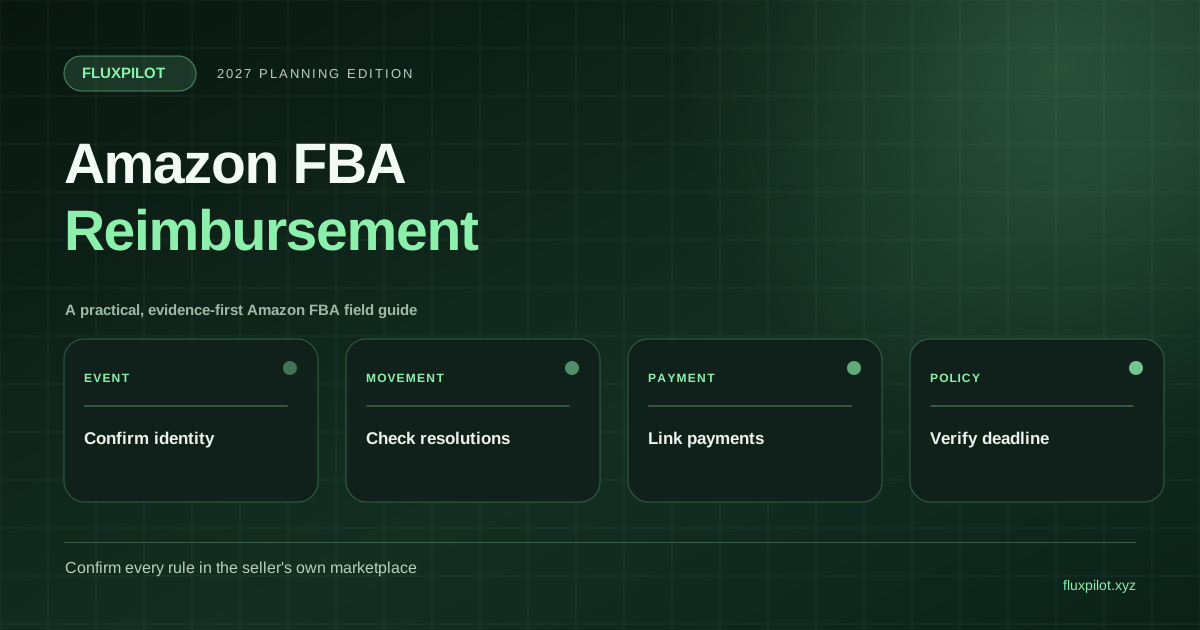
As of October 9, 2026, Amazon has not issued a universal 2027 reimbursement rulebook that this guide can verify. Prepare a recurring, marketplace-specific audit now: retain original Inventory Ledger and reimbursement exports, separate inbound shortages from warehouse losses, confirm each deadline in Seller Central, reconcile later inventory resolutions, verify documented product costs and record the next action for each incident.
What is actually known about 2027—and what is not
This is an early planning guide published October 9, 2026, not a claim that Amazon has announced all 2027 policies. Search queries containing 2027 can appear months ahead of the year itself. A responsible guide separates established rules from updates that may arrive later.
Current official announcements establish some important reference points. Amazon's US forum update effective October 15, 2025 listed claim windows by incident type. A separate Europe forum announcement effective September 23, 2026 reduced the missing-from-inbound maximum claim window to 30 days, with a transition period and a required wait before filing. Neither announcement should be represented as a globally uniform 2027 policy.
Before any specific filing, check the policy displayed inside the seller account, record the marketplace and event category, and note the date on which the policy was verified. When a rule changes, update the affected review workflow instead of silently changing historical event dates.
| Scope | Published signal | What to verify later |
|---|---|---|
| US · warehouse item reported lost/damaged | Within 60 days of the reported loss/damage (Oct 2025 update) | The current help-page definition and event timestamp |
| US · qualifying customer returns | 45–105 days after customer refund/replacement (Oct 2025 update) | The return category and any automatic handling |
| US · removal order reported lost | 15–135 days from removal shipment creation (Oct 2025 update) | Category exceptions and current removal policy |
| Europe · missing from inbound shipments | 30-day maximum effective Sep 23, 2026; transitional arrangements through Oct 23 | The exact local Contents workflow and receive date |
| Europe · missing-from-inbound filing start | Wait at least 14 days after shipment receipt (Sep 2026 announcement) | Whether the shipment is ready for investigation |
The four evidence checkpoints that stay useful across policy changes
Start with event identity. A seller should be able to answer which seller account, marketplace, event type, report period and original reference an apparent loss belongs to. A SKU or ASIN alone can represent multiple distinct events.
Next establish inventory resolution. An initially negative adjustment may be followed by a found movement, restock or correction. Do not count the same resolution twice merely because it appears in multiple reports. Third, examine reimbursement history with original payment and reversal references rather than checking whether the product appears anywhere in a cash report.
Fourth, validate valuation. For eligible inventory lost or damaged before a customer order, published policy shifted emphasis to manufacturing or sourcing cost rather than treating the retail selling price as the default payout. Keep date-appropriate invoices or production records and the currency alongside the event; a calculated gap is an estimate, not a promised Amazon reimbursement.
- Checkpoint 1: identify the incident and preserve the exact original export row.
- Checkpoint 2: account for later found, corrected or inventory-compensated units once.
- Checkpoint 3: link cash, inventory reimbursements and reversals only with defensible evidence.
- Checkpoint 4: attach documented cost and the current policy before deciding whether to act.
Build a deadline register before January 2027
A good register does not store one global 60-day deadline. It contains account, marketplace, claim category, source date, policy source, earliest filing date if any, latest filing date if confirmed, reviewer and next action. The same product may have a warehouse loss in one row and an inbound shortage in another; those clocks should never be merged.
For Europe missing-from-inbound, the September 2026 announcement gives a specific example of why this matters: the filing window was reduced and the official notice still required sellers to wait at least 14 days after receipt. If a seller simply sets all new cases to 'wait 45 days' based on older advice, the relevant window may be missed.
Record unresolved dates as 'policy verification required', not as invented future deadlines. A team can then prioritize both verified near-term windows and unknown categories that need official clarification.
| Column | Example (fictional) | Rule |
|---|---|---|
| Marketplace | EU seller account | Never assume US windows apply |
| Category | Missing from inbound | Separate from FC inventory loss |
| Source event date | Shipment received Dec 12 | Keep Amazon source timestamp |
| Earliest action | Verify official waiting period | Do not file early |
| Latest action | Confirm rule in Seller Central | Do not forecast future terms |
| Resolution status | Unmatched · needs check | Do not call it recoverable until verified |
Worked example: five missing units are not automatically five payable units
Assume a fictional US seller exported a detailed Inventory Ledger that shows five affected units at an event reference R-101. Two units later returned to inventory. Another payment history row shows a $24 cash reimbursement, but the event link is unclear. The purchase documentation shows $12 per unit.
First, the remaining quantity for a cost comparison is three units, for $36. Second, the $24 payment must not be subtracted simply because it has the same ASIN; verify the original reimbursement reference and what incident it covered. If the link is confirmed, the arithmetic estimate is $12, not a filing recommendation. If it is unconfirmed, the state remains 'possible match' and the cash should be reviewed separately.
Finally, check the claim category, its current policy and whether any later movement resolves the units. The article is illustrating record discipline, not an assertion that Amazon owes $12. FluxPilot's free calculator can check arithmetic for one incident; it does not itself determine eligibility.
A weekly review workflow for small and growing FBA sellers
Set a repeatable weekly review for active seller accounts. Record the period each export covers. Keep raw files unchanged and label working copies with the export timestamp so the same transactions do not count twice when a later report overlaps.
Start with high-confidence events and verified, near-term deadlines. Next investigate the missing reference, inventory movement or cost evidence on borderline cases. At the end of the review, classify each record as resolved in inventory, paid, partially explained, awaiting Amazon clarification, incomplete data or candidate for a policy-checked manual case.
For teams handling hundreds of SKUs, keep a case owner and a short audit history with the evidence links and next date to review. This is more reliable than downloading one huge CSV every quarter and treating every negative quantity as newly lost.
- Monday: pull source exports, record market and date range.
- Tuesday: check later stock movements and reimbursement references.
- Wednesday: document unresolved events and source costs.
- Thursday: verify marketplace-specific policy clocks; escalate only evidence-backed cases.
- Friday: update payment, unit and case statuses; retain reasons for closures.
How to compare FBA reimbursement workflows before 2027
A spreadsheet offers direct control but requires manual joins. A managed service may handle some investigations, but the contract should specify permissions, fee calculation, exclusions and whether you keep your case evidence. Software can save reconciliation steps, yet feature claims should be tested on the exact reports and marketplaces the seller uses.
Ask for a small test that includes a later inventory correction, a partial payment and an overlapping export. A provider that shows a big 'recoverable' total without resolving those distinctions can create false expectations. Compare time spent obtaining traceable conclusions, not only headline amounts.
FluxPilot currently focuses on supported Inventory Ledger lost/damaged review, optional sourcing-cost and reimbursement-history input, and organized findings. It does not submit claims automatically, process every reimbursement category or guarantee a cash recovery.
Frequently asked questions
Are the Amazon FBA reimbursement rules for 2027 already confirmed?
No universal 2027 rule set is verified here. This planning edition documents specific policies published before 2027 and tells you where to confirm current terms when you act.
Is the FBA lost-inventory claim window always 60 days?
No. Incident types and marketplaces differ. The cited US announcement includes a 60-day fulfillment-center lost/damaged window, while a later Europe announcement describes a different 30-day missing-from-inbound window.
Does an Inventory Ledger discrepancy prove Amazon owes me money?
No. Verify later movements, prior reimbursements, event identity, accepted valuation and eligibility before treating a discrepancy as a possible claim.
Will FluxPilot automatically file reimbursement cases?
No. FluxPilot currently helps organize supported lost/damaged Inventory Ledger review and compare supplied cost and payment history.
Sources and further reading
Workflows and examples are from FluxPilot. Amazon policies change; verify the current policy for your marketplace before filing a claim.
Amazon US claim-window update (effective Oct 15, 2025) Amazon Europe missing-from-inbound update (Sep 23, 2026) Amazon FBA inventory reimbursement policy (marketplace dependent) Amazon official FBA report definitions