
KDP AI-Generated vs AI-Assisted Content: What Authors Must Disclose
Amazon KDP AI disclosure rules explained with text, cover, image and translation examples, a publication checklist, and the difference between AI-generated and AI-assisted.
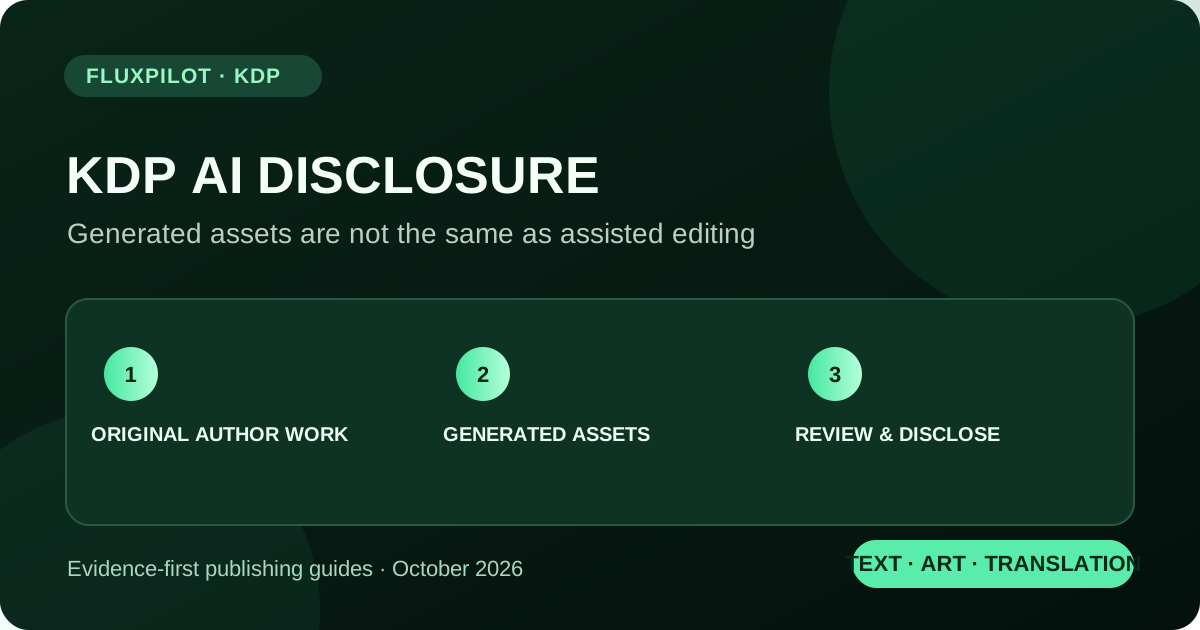
KDP requires publishers to inform Amazon about AI-generated text, images or translations included in new or republished books. KDP distinguishes this from AI-assisted brainstorming, proofreading or editing of content originally created by a person; AI-assisted use alone generally does not require the same disclosure. Substantial editing of AI-generated output does not erase the disclosure requirement.
Read Amazon's definition before making assumptions
Amazon's KDP Content Guidelines distinguish AI-generated and AI-assisted content by who or what created the actual asset. If an AI tool created the text, images or translations included in the book, KDP considers those assets AI-generated even if the author later makes substantial edits.
If the person wrote or created the content and used software to brainstorm, edit, refine or check their own work, KDP describes that as AI-assisted. An author should keep enough evidence of their own process to answer questions consistently, especially when multiple tools or contributors were involved.
Examples: which uses should be disclosed?
Think about actual outputs, not marketing labels on tools. A generator that supplies a final page of prose used in your published book is materially different from a spellchecker identifying a typo in prose you created. Similarly, a generated cover image is an actual asset even if the layout and title were assembled by a human.
These examples are interpretations of Amazon's published definitions; complex edge cases should be reviewed against the latest KDP publishing form and, if necessary, clarified with KDP support.
| Scenario | Likely classification | Practical action |
|---|---|---|
| AI creates finished chapter used in book | AI-generated text | Disclose generated text |
| AI creates cover illustration | AI-generated image | Disclose generated image |
| AI translates chapters used in release | AI-generated translation | Disclose generated translation |
| Human writes chapter; AI flags typos | AI-assisted | No generated-content disclosure solely for that use |
| AI proposes themes; human writes actual text | AI-assisted | Keep your own creation workflow |
| AI creates draft; human rewrites heavily | AI-generated origin | Disclose under KDP's definition |
The cover counts, not just the manuscript
AI artwork used on a print or eBook cover is within Amazon's disclosure policy. So are AI-generated illustrations inside activity books, journals and children's books. A publisher should not check only the manuscript and forget the creative process that produced the cover.
Rights and compliance are separate questions. Disclosure does not prove commercial rights, originality, truthfulness or permission to imitate recognizable brands, living artists, characters or other copyrighted work. Validate licenses and intellectual property risks independently.
- Inventory generated text, image and translation assets.
- Identify whether assets appear in the final submitted files.
- Check license or rights evidence for every external asset.
- Ensure covers and metadata reflect the real book.
- Review quality, factual accuracy and audience suitability.
A practical editorial record for creators
Keep an internal spreadsheet with columns for page or chapter, tool purpose, creator, draft source, human review and disposition. For a cover, record whether the image itself was generated, stock licensed or made by your own designer. For manuscripts, note whether AI simply suggested improvements or produced passages you used.
This record is not a substitute for KDP's own disclosure process. It is an audit trail that helps you answer the disclosure question honestly when revising and republishing editions.
| Asset | Created by | AI role | Action |
|---|---|---|---|
| Chapter 1 | Author | Proofreading suggestions | Retain author draft |
| Cover illustration | Image-generation tool | Final asset creation | Disclose as generated image |
| Back-cover copy | Author | Brainstorming concepts | Keep revision record |
| Translation | Translation generation tool | Produced published text | Disclose generated translation |
What to do when publishing or updating a title
Before submission, open the current KDP Content Guidelines and inspect the actual AI disclosure field during book setup. Answer based on the content you are publishing, not on a generic statement that the entire book is 'AI-written' or 'AI-free'. Verify the wording again when making edits and republishing.
KDP says publishers must inform it when AI-generated content appears in a new or republished book. There is no exemption solely because the content was substantially modified later. KDP also continues to hold the publisher responsible for quality and rights.
Use AI to plan without outsourcing your responsibility
FluxPilot AI Book Creator can propose original ideas, titles, chapter structures and reader-intent phrases. Treat these as starting points to evaluate, not validated sales opportunities, cleared trademarks or publication-ready manuscripts.
If you use an assistant-generated outline and then write the pages yourself, compare that process with KDP's AI-assisted definition. If you copy model-generated paragraphs into the final book, assess those assets as AI-generated. Maintain honest descriptions and check the current disclosure wording before submitting.
Avoid myths about detection and enforcement
Online discussions frequently speculate about whether Amazon 'detects' undisclosed AI automatically. Amazon's policy, not rumors about detection accuracy, is the enforceable standard. The precise enforcement methods and consequences in individual cases are not reliably knowable from anonymous comments.
Focus on useful human review: facts, originality, coherence, accessibility and copyright compliance. Honest disclosure and careful quality control protect the reader more effectively than trying to guess what a detection model might flag.
Frequently asked questions
If I rewrite AI-generated chapters, must I still disclose?
KDP says content created by an AI-based tool is AI-generated even after substantial edits; review the current disclosure form.
Does AI proofreading count as AI-generated?
If you originally created the content and used AI to edit or error-check, KDP describes this as AI-assisted rather than generated.
Does a generated book-cover illustration count?
Yes. KDP explicitly includes AI-generated cover and interior images in its disclosure requirement.
Sources and further reading
Original guidance by FluxPilot, cross-checked against KDP documentation. Amazon policies and marketplace rules can change; verify current requirements before publishing.
KDP: Content Guidelines (AI-generated and AI-assisted) KDP: Metadata Guidelines