
KDP Paperback Royalties: 50% vs 60%, $9.99 Pricing and Real Print Costs
Understand KDP paperback royalties at $9.98 versus $9.99, estimate print costs and model margin before publishing a low-content book or workbook.
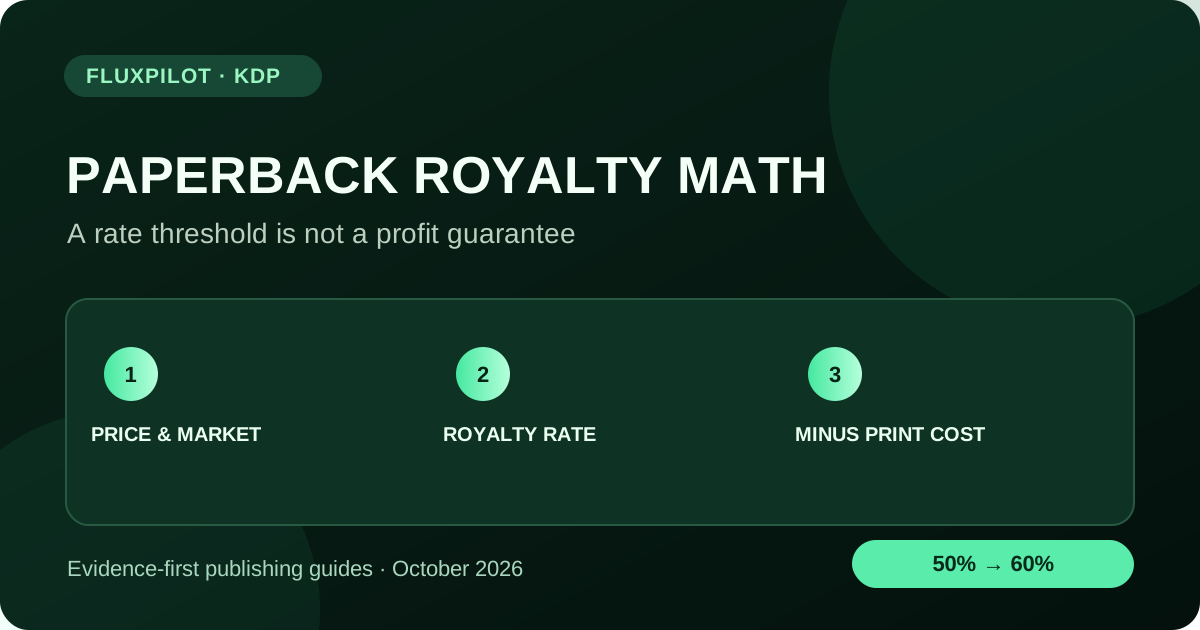
For paperbacks sold on Amazon.com, KDP applies a 50% royalty rate at list prices of $9.98 or below and 60% from $9.99, minus the printing cost in either case. The actual royalty depends on page count, ink, paper, trim size and marketplace. Use the official KDP calculator for current estimates; do not interpret royalty rate as profit margin.
Why $9.99 matters for Amazon.com paperbacks
Amazon KDP's official paperback royalty table has two standard Amazon distribution rates for US dollar list prices: 50% when the price is at or below $9.98, and 60% when it is at or above $9.99. The royalty paid to a publisher is not simply 50% or 60% of the price. KDP also subtracts printing costs.
Other marketplaces have different thresholds and currencies. Amazon.co.uk, for example, uses a threshold in pounds; do not convert the US $9.99 trigger mechanically into every marketplace. Expanded Distribution has a separate 40% royalty calculation where available.
The correct royalty equation
Start with the formula: royalty = (list price × applicable royalty rate) − printing cost. The printing cost is not optional, and the price Amazon displays to buyers can be affected by marketplace tax treatment. For a valid comparison, hold book specifications and marketplace constant.
Suppose you sell a hypothetical book on Amazon.com with a $2.30 print cost. At $9.98, the estimated standard royalty is (0.50 × 9.98) − 2.30 = $2.69. At $9.99, it is (0.60 × 9.99) − 2.30 = $3.69 when rounded to cents. These are illustrative arithmetic examples, not actual quotes for every book.
| List price | Rate | Print cost assumption | Estimated royalty |
|---|---|---|---|
| $8.99 | 50% | $2.30 | $2.20 |
| $9.98 | 50% | $2.30 | $2.69 |
| $9.99 | 60% | $2.30 | $3.69 |
| $12.99 | 60% | $2.30 | $5.49 |
Where the $2.30 printing example comes from
For certain Amazon.com black-ink, standard-trim paperbacks between 24 and 110 pages, KDP's current published print-cost table lists a fixed $2.30 charge. Large trim options, color pages and different page counts have different costs. Always verify the exact combination before reusing the example.
Above the fixed-cost range, KDP generally uses a fixed charge plus a per-page component. For many books, a seemingly small trim, ink or page-count change changes the cost of manufacturing enough to affect viable pricing.
A practical pre-publish pricing test
Take a proposed title and calculate at least three realistic list prices. Write down the expected royalty and compare it to comparable books the same audience might choose. If a $9.99 price creates more royalty per copy but makes the book less competitive for its value, the higher arithmetic return does not guarantee better total earnings.
Include production and marketing effort in the business decision. KDP royalty does not include the cost of creating an interior, paying a designer, advertising or purchasing a proof copy. A book that yields $3.69 in platform royalty may still have a smaller net business contribution after those costs.
- Confirm marketplace and format; paperback and eBook are priced differently.
- Enter final trim size, page count, ink and paper settings.
- Compare price points on identical specifications.
- Check current minimum list price and Expanded Distribution eligibility.
- Recalculate after making layout changes.
Example: a short planner versus a color activity book
A 100-page black-ink standard-trim planner can fall into a flat print-cost range; a color activity book may have a much higher charge. They should not share the same target price merely because the two covers look similar.
Before positioning a product as low-content, verify KDP's classification. A notebook with repetitive ruled pages is generally low-content; a puzzle or coloring book is not generally classified that way. Classification affects certain publishing options, and cost still depends on print specifications.
Use a range instead of a magic profit number
Forecasting income from a new paperback is uncertain without verified demand and conversion data. Build best-case and conservative scenarios explicitly marked as assumptions: hypothetical unit sales × estimated royalty. For example, 20 copies at a $3.69 estimate is $73.80 in estimated platform royalties before other costs—not a sales prediction.
FluxPilot's public KDP Studio provides an illustrative royalty calculator for planning. For current marketplace-specific outputs, cross-check with Amazon's official Printing Cost & Royalty Calculator. Neither calculator guarantees sales.
Avoid the three most expensive pricing mistakes
Do not use paperback rules for eBooks. Do not ignore the rate threshold when testing $9.98 versus $9.99. Do not calculate profit from royalty alone. Every scenario should name its assumptions and distinguish platform royalty from take-home business profit.
Recheck the official policy before editing a live title because rates and print-cost tables can change, and market-specific tax treatments complicate cross-border comparisons. A repeatable pricing worksheet is safer than a 'best KDP price' claim.
Frequently asked questions
Is the KDP paperback royalty always 60%?
No. The rate depends on the marketplace and price threshold, and printing costs are subtracted.
Does raising a paperback from $9.98 to $9.99 always increase sales?
No. It can increase royalty per copy under the stated US paperback rules, but sales volume and conversion remain unknown.
Can I calculate a color paperback with the $2.30 figure?
No. That illustrative figure applies to specified black-ink, standard-trim combinations. Use current KDP print-cost estimates for your own specification.
Sources and further reading
Original guidance by FluxPilot, cross-checked against KDP documentation. Amazon policies and marketplace rules can change; verify current requirements before publishing.
KDP: Paperback Royalty KDP: Paperback Printing Cost KDP: Official Calculator